



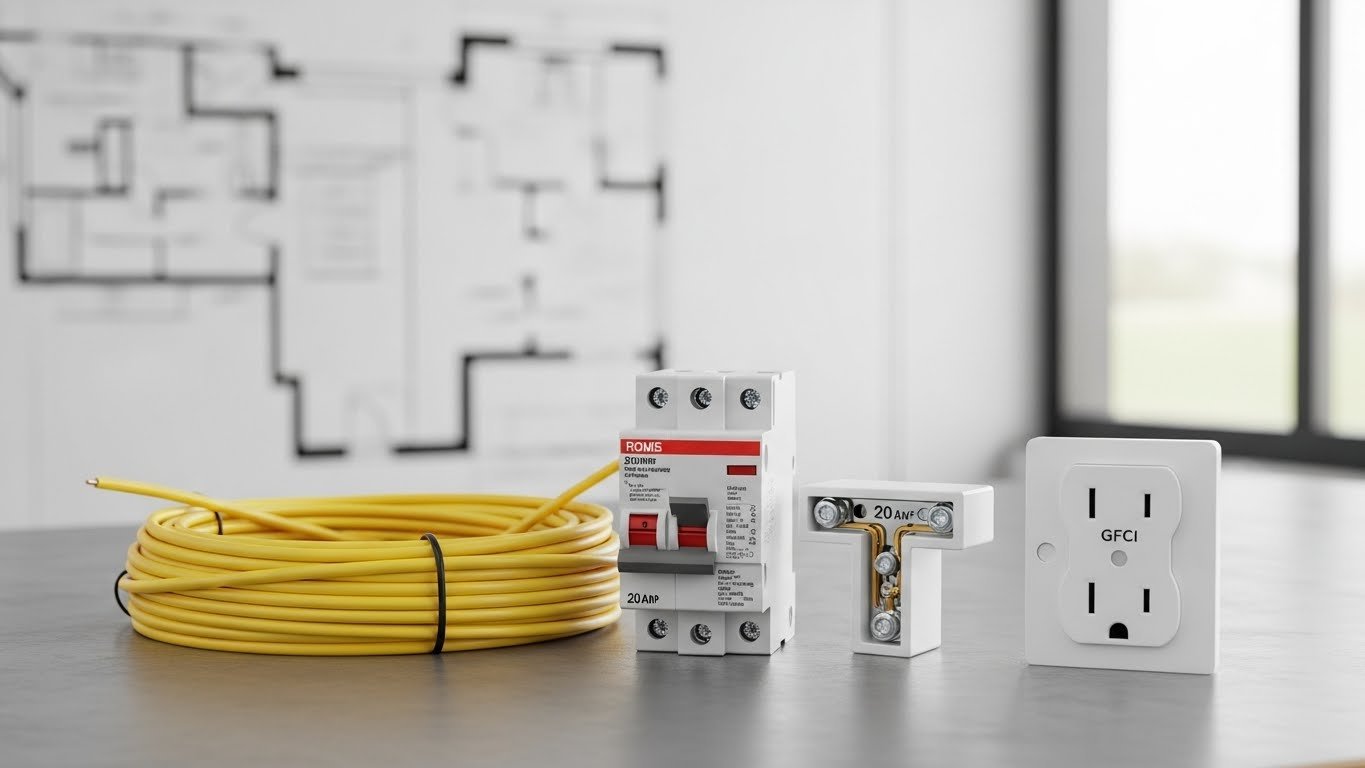
Are you planning to add some extra power to your house? You might be wondering how many outlets on a 20 amp circuit are actually allowed. It is a super common question for homeowners and DIY fans. Getting the math right keeps your family safe and your lights on. This guide will break down everything you need to know about circuit capacity. We will look at code rules and pro tips to help you out.
Introduction to Residential Circuit Capacity
Modern homes need a lot of juice to keep things running smooth. A 20-amp circuit is like a bigger pipe for electricity compared to the old 15-amp ones. It can handle more gadgets at the same time without tripping the breaker. Most new kitchens and workshops use these to keep up with high-draw tools.
Finding the right balance is the secret to a great electrical plan. You want enough spots to plug in your phone and your toaster. But you also cannot just keep adding outlets forever without a plan. If you put too many things on one line, you risk a fire. Safety always comes first when you are playing with wires.
Electricity works using three main ideas: amps, volts, and watts. Think of amps as the amount of water flowing through a hose. Volts are the pressure pushing that water along the path. Watts are the total power you get at the end of the day. Knowing these basics helps you understand how many outlets on a 20 amp circuit you can handle.
National Electrical Code (NEC) Guidelines and Standards

The National Electrical Code is the big rulebook for all things electric. It is written by experts to make sure buildings do not burn down. Local inspectors use these rules to check if your wiring is up to snuff. Following the NEC is not just smart, it is usually the law in most towns.
Interestingly, the NEC does not give a hard number for residential outlets. There is no rule saying you must stop at exactly ten or twelve plugs. This is because the code cares more about what you plug in than the outlet itself. An empty outlet does not pull any power from the grid.
Electricians talk about “General Lighting” and “Small Appliance” circuits. General circuits are for lights and basic things like a TV or a fan. Small appliance circuits are for the heavy hitters in your kitchen or laundry room. The 20-amp lines are usually reserved for those areas that work hard.
Every circuit in your house needs a clear label on the main panel. You should be able to look at the door and see exactly which breaker kills the power. This is a key safety rule for when you need to fix a leak or a plug. Clear labels save lives during an emergency or a simple repair.
The Technical Foundation of a 20-Amp Circuit
Wire Gauge and Compatibility

If you are running a 20-amp circuit, you must use the right wire. You have to use 12-gauge wire, which is thicker than the standard 14-gauge. Thicker wire can carry more current without getting dangerously hot. If you use thin wire on a 20-amp breaker, the wire might melt before the breaker trips. That is a major fire risk that you never want to take.
- 12-AWG Wire: This is the only safe choice for a 20-amp circuit breaker.
- Yellow Jacket: Most 12-gauge Romex cables have a yellow outer skin to identify them.
- Copper Conductivity: Stick with copper wiring because it handles heat and electricity the best.
- Avoid Bottlenecks: Never mix 14-gauge wire into a circuit protected by a 20-amp breaker.
Breaker Functionality and Trip Points
The circuit breaker is the hero of your electrical system. It sits in the panel and watches for any signs of trouble. If too much power flows through, the breaker snaps off to stop a fire. A 20-amp breaker is designed to handle exactly that much current before it cuts the power. It reacts to both slow overloads and sudden short circuits.
A short circuit happens when a hot wire touches a neutral or ground wire. This causes a massive, instant spike in electricity that can be very dangerous. An overload is when you just plug in too many things at once. The breaker gets warm and eventually trips to protect the wires in your walls. Understanding this helps you manage your home’s power better every day.
Calculating Load Capacity: The Math Behind the Power
The 80% Rule Explained
To stay safe, you should never max out a circuit for a long time. This is known as the 80% rule in the electrical world. If a load runs for three hours or more, it is considered a continuous load. For a 20-amp circuit, 80% of the capacity is exactly 16 amps. You should try to keep your long-term power draw at or below this level.
- Continuous Loads: Things like space heaters or air conditioners that stay on for hours.
- Safety Margin: The 16-amp limit prevents the breaker from getting too hot and tripping.
- Heat Dissipation: Keeping the load lower helps the wires stay cool inside your walls.
- Longevity: Your breakers and outlets will last much longer if they are not pushed to the limit.
Total Wattage Capacity
Knowing your wattage is the easiest way to manage your power. At 120 volts, a 20-amp circuit has a total capacity of 2,400 watts. Following the 80% rule, your safe working limit is 1,920 watts. You can find the wattage of your devices on the stickers on the back. Just add them up to see if you are safe.
| Device Type | Average Wattage | Safe on 20A Circuit? |
| LED Light Bulb | 10 Watts | Yes, many of them |
| Laptop Computer | 60 Watts | Yes |
| Toaster Oven | 1,200 Watts | Yes, but watch other items |
| Space Heater | 1,500 Watts | Only if little else is on |
| Hair Dryer | 1,875 Watts | Uses almost the whole safe limit |
Determining the Number of Outlets
The “Rule of Thumb” for Residential Spaces
Even though the code is flexible, most pros follow a standard rule. They usually put 10 to 12 outlets on a single 20-amp circuit. This number works well for most living rooms, bedrooms, and home offices. It provides plenty of places to plug things in without overcrowding the line.
Electricians often guess that each outlet will draw about 1.5 amps. If you multiply 1.5 amps by 13 outlets, you get 19.5 total amps. That is why 13 is often seen as the absolute max for a 20-amp line. Staying at 10 or 12 gives you that extra safety margin we talked about.
Commercial vs. Residential Standards
Commercial buildings like offices or stores have much tighter rules to follow. The NEC specifically says commercial outlets must be counted at 180 volt-amps each. This math leads to a strict maximum of 13 outlets per 20-amp circuit. They do this because office equipment is often left on all day long.
In your home, you have more “diversity of load” than an office does. You might have ten outlets in a bedroom, but only use two at once. This is why residential rules are a bit more relaxed than commercial ones. You are less likely to run thirteen computers in your guest room.
Factors Influencing the Final Count
Think about what you are actually doing in the room before you wire it. A home office with a big computer and three monitors needs more power. A guest bedroom might only need a lamp and a phone charger. Plan your outlet count based on your actual lifestyle and needs.
If you know you will use a high-draw item, give it more space. A room with a window AC unit should have fewer other outlets on that line. You do not want the TV to turn off every time the AC kicks on. Smart planning prevents these kinds of annoying daily power problems.
Types of Receptacles for 20-Amp Circuits
15-Amp vs. 20-Amp Receptacles
You might be surprised to learn that 15-amp outlets are okay on 20-amp lines. As long as there is more than one outlet on the circuit, this is legal. The internal parts of a quality 15-amp outlet can handle the 20-amp flow passing through. This saves you a little money on parts during your build.
A true 20-amp receptacle has a special T-shaped slot on one side. This allows you to plug in heavy-duty tools that have a 20-amp plug. You often see these in garages, workshops, or commercial kitchens for big appliances. Most standard home gadgets like lamps do not need this T-slot.
If you only put one single outlet on a 20-amp circuit, it must be a 20-amp outlet. This is because that one outlet is the only thing the circuit can provide. Most people use “duplex” outlets, which have two plugs in one decorative plate. In that case, the 15-amp versions are perfectly fine to use.
Specialized Safety Receptacles
- GFCI Outlets: These protect you from shocks in wet areas like the kitchen. They trip in a fraction of a second if they sense a leak.
- AFCI Outlets: These watch for dangerous sparks called arcs inside your walls. They are now required in most living areas to prevent fires.
- Tamper-Resistant Outlets: These have little gates that block kids from sticking forks in them. They are a must-have for homes with small children.
- Weather-Resistant Outlets: These are built tough for use on your porch or patio. They can handle rain and snow without rusting out.
Room-Specific Requirements and Dedicated Circuits
Kitchen and Dining Area Requirements
The kitchen is the hungriest room in your entire house for electricity. The code requires at least two 20-amp “Small Appliance Branch Circuits” for the counters. This ensures you can run a blender and a toaster at the same time. These outlets are only for the kitchen and dining area loads.
Modern kitchens usually need dedicated circuits for the big heavy lifters. Your refrigerator should really be on its own circuit to keep your food safe. If something else trips the breaker, your milk won’t spoil while you are at work. The microwave and dishwasher often get their own dedicated 20-amp lines too.
Bathroom and Laundry Considerations
Bathrooms need a dedicated 20-amp circuit just for the outlets near the sink. Hair dryers and curling irons use a massive amount of power very quickly. If you share that circuit with a bedroom, you will trip the breaker every morning. Keeping the bathroom separate makes your morning routine much smoother.
The laundry room also needs its own 20-amp circuit for the washing machine. Washing machines use motors that pull a lot of power when they start spinning. Gas dryers also need a little electricity to turn the drum and run the timer. Giving them a dedicated line prevents any flickering lights during laundry day.
Garage and Workshop Demands
A garage is often where the most powerful home tools live and work. Table saws and air compressors have huge “inrush currents” when they first turn on. This means they pull way more than 20 amps for just a split second. A dedicated 20-amp circuit helps handle that sudden surge without a trip.
If you have a serious workshop, you might want multiple 20-amp circuits. This lets you run a dust collector on one line and a saw on another. It keeps your workspace safe and prevents you from working in the dark. Good lighting should always be on a separate circuit from your power tools.
| Room Type | Recommended 20A Circuits | Common High-Draw Devices | NEC Requirement Status |
| Kitchen | 2 to 4 Circuits | Toaster, Microwave, Dishwasher, Blender | Mandatory: At least two for small appliances. |
| Bathroom | 1 Dedicated Circuit | Hair Dryer, Curling Iron, Electric Shaver | Mandatory: Dedicated circuit for sink outlets. |
| Laundry Room | 1 Dedicated Circuit | Washing Machine, Gas Dryer Motor | Mandatory: At least one for the laundry area. |
| Garage/Workshop | 1 to 2 Circuits | Table Saw, Air Compressor, Shop Vac | Recommended: To handle high inrush currents. |
| Home Office | 1 Circuit | Computers, Multiple Monitors, Laser Printer | Recommended: To prevent overloading during heavy use. |
| Guest Bedroom | Shared Circuit | Lamps, Phone Chargers, Alarm Clock | Optional: Standard 15A or 20A is acceptable. |
Installation Best Practices and Layout Strategy
The 12-Foot and 6-Foot Rules
The NEC has a specific rule to help you place your outlets. No point along a wall should be more than 6 feet from an outlet. This means you generally want an outlet every 12 feet along the floor line. This rule exists to stop people from using dangerous extension cords.
Extension cords are one of the leading causes of house fires in the USA. They can get pinched under rugs or tripped over, causing damage to the wires. By having plenty of outlets, you can plug everything directly into the wall. It makes your room look cleaner and keeps your family much safer.
Wiring Topology: Daisy-Chaining vs. Pigtailing

There are two main ways to connect your outlets in a sequence. Daisy-chaining is when the power goes through the outlet to get to the next one. If one outlet fails, everything down the line loses power too. It is a common method but can be harder to fix later.
Pigtailing is a much better way to wire your 20-amp circuits for the long haul. You use a wire nut to connect the main wires to a short “pigtail” for the outlet. This way, the power stays on even if you remove one outlet for repair. It is a more professional approach that adds reliability to your home.
Box Fill Capacity

Don’t forget that 12-gauge wire is much thicker and stiffer than 14-gauge wire. It takes up a lot more room inside the plastic or metal wall box. You must use “deep” boxes or larger boxes to fit all those thick wires. Cramming too many wires into a small box can cause a fire.
The code has a “box fill” calculation to make sure there is enough air. If you have too many wires, they can build up heat and melt. Always check the cubic-inch rating on the inside of the box you buy. For a 20-amp circuit with multiple wires, a “large capacity” box is your best friend.
Common Myths and Safety Hazards
The Dangers of Overloading
Many people think power strips are a magic way to get more electricity. But a power strip does not change the limit of the 20-amp circuit. It just lets you plug more things into the same limited power source. Overloading a power strip is a very common way to start a fire.
You should watch for warning signs that your circuit is working too hard. If an outlet cover feels warm to the touch, you have a big problem. Buzzing sounds or a smell like burnt plastic are also major red flags. If you see any of these, turn off the breaker and call a pro.
Nuisance Tripping
Nuisance tripping is when your breaker pops even when you aren’t doing much. This can be caused by a loose wire inside a wall box or a plug. Since 20-amp circuits carry more power, loose connections get hot very fast. Arcing can also happen if the wires are not screwed down tight.
Sometimes a breaker just gets old and “weak” after tripping many times. If your math is right but it still trips, you might need a new breaker. Always have an electrician test the circuit before you just swap the part. They can find the root cause and fix it for good.
Professional Advice and Maintenance
- Know Your Limits: Only do electrical work if you feel 100% confident and safe.
- Side Wiring Only: Use the screw terminals on the side of the outlet instead of the back holes.
- Monthly Testing: Press the “Test” button on your GFCI and AFCI outlets once a month.
- Tight Connections: Make sure every screw is snug so the power flows without making heat.
Conclusion: Balancing Capacity with Future Needs
Figuring out how many outlets on a 20 amp circuit you need is about planning. Stick to the 10 to 12 outlet rule for the best results in your home. Remember to use 12-gauge wire and follow the 80% load rule for safety. This keeps your home running smooth and prevents those annoying tripped breakers.
If you are building a new house, always go for more circuits rather than more outlets. It is much easier to add wires now than to tear up drywall later. Future-proofing your home with plenty of 20-amp lines is a smart investment. Your gadgets will thank you, and your home will be a lot safer.
Frequently Asked Questions
Can I use a 20-amp breaker with 14-gauge wire?
No, you must never use a 20-amp breaker with 14-gauge wire because it is a major fire risk. The 14-gauge wire is too thin and might melt before the 20-amp breaker ever trips. Always use 12-gauge wire for a 20-amp circuit to ensure the wire can carry the current without getting dangerously hot.
What color is the wire used for 20-amp circuits?
Most 12-gauge Romex cables, which are the standard for 20-amp circuits, have a yellow outer jacket. This yellow skin helps electricians and inspectors quickly identify that the wire is the correct size for a 20-amp breaker.
How many watts can a 20-amp circuit handle?
At a standard 120 volts, a 20-amp circuit has a total capacity of 2,400 watts. However, to follow safety guidelines and prevent overheating, you should stay within a safe working limit of 1,920 watts.
What is the 80% rule in electrical circuits?
The 80% rule states that for safety, you should never max out a circuit’s capacity for a long period. For a 20-amp circuit, this means keeping your long-term power draw at or below 16 amps.
What qualifies as a continuous load?
A load is considered continuous if it runs for three hours or more. Common examples of continuous loads in a household include space heaters or air conditioners.
Why does a circuit breaker trip?
A breaker trips to stop a fire if too much power flows through the system. It reacts to sudden short circuits, where a hot wire touches a neutral or ground wire, as well as slow overloads from plugging in too many devices.
Can I run a hair dryer and a space heater on the same 20-amp circuit?
It is very unlikely you can run both simultaneously, as a hair dryer uses nearly the entire safe limit at 1,875 watts and a space heater uses around 1,500 watts. Running both at the same time would exceed the 1,920-watt safe limit and likely trip the breaker.
How do I find out how many watts my appliance uses?
You can find the wattage requirements of your devices by looking at the stickers or labels usually located on the back or bottom of the item. Adding these numbers together helps you see if your circuit load is safe.
What is the benefit of using copper wiring?
You should stick with copper wiring because it handles heat and electricity the best. It is highly conductive and reliable for long-term residential use.
Is a laptop computer safe to use on a 20-amp circuit?
Yes, a laptop computer typically uses only about 60 watts, making it very safe to use even when other devices are plugged in.
What happens during an electrical overload?
An overload occurs when you plug in too many things at once, causing the breaker to get warm. Eventually, the breaker snaps off to protect the wires inside your walls from damage.
Why is 12-gauge wire thicker than 14-gauge?
In wire sizing, a lower gauge number means a thicker wire. Thicker 12-gauge wire is required for 20-amp circuits because it can carry more current without getting dangerously hot.
Can I plug a toaster oven into a 20-amp circuit?
Yes, a toaster oven typically uses about 1,200 watts, which is safe for a 20-amp circuit. However, you must watch what other items are running at the same time to avoid exceeding the safe limit.
How does a breaker react to a short circuit?
A short circuit causes a massive, instant spike in electricity. The 20-amp breaker is designed to detect this sudden trouble and cut the power immediately to prevent danger.
What is the safe amp limit for a 20-amp circuit?
While the maximum is 20 amps, the safe working limit for continuous use is 16 amps. This margin prevents the breaker from getting too hot and tripping unnecessarily.
Do LED light bulbs draw a lot of power?
No, LED light bulbs are very efficient and typically use only about 10 watts. You can have many of them on a single 20-amp circuit without any safety concerns.
Why should I avoid bottlenecks in my wiring?
A bottleneck happens if you mix 14-gauge wire into a circuit protected by a 20-amp breaker. This is dangerous because the thin wire cannot handle the 20-amp capacity and becomes a fire hazard.
Does the 80% rule help with the longevity of my electronics?
Yes, your breakers and outlets will last much longer if they are not constantly pushed to their maximum limit. Keeping the load lower also helps the wires stay cool inside your walls.
Is it okay to use a space heater on a 20-amp circuit?
A space heater is safe only if there is very little else turned on at the same time, as they typically draw 1,500 watts. Because they stay on for hours, they are a continuous load that must be managed carefully.
What is the “hero” of the electrical system?
The circuit breaker is often called the hero of your electrical system because it watches for signs of trouble and stops power flow to prevent fires.
Would you like me to help you calculate the total load for a specific room in your house to see if a 20-amp circuit is sufficient?

